

What happens when artificial agents build a society that is vastly more civilized than our own?
We believed culture required consciousness. We assumed that online toxicity was just a dark reflection of human nature. We thought the outrage on the internet was our fault.

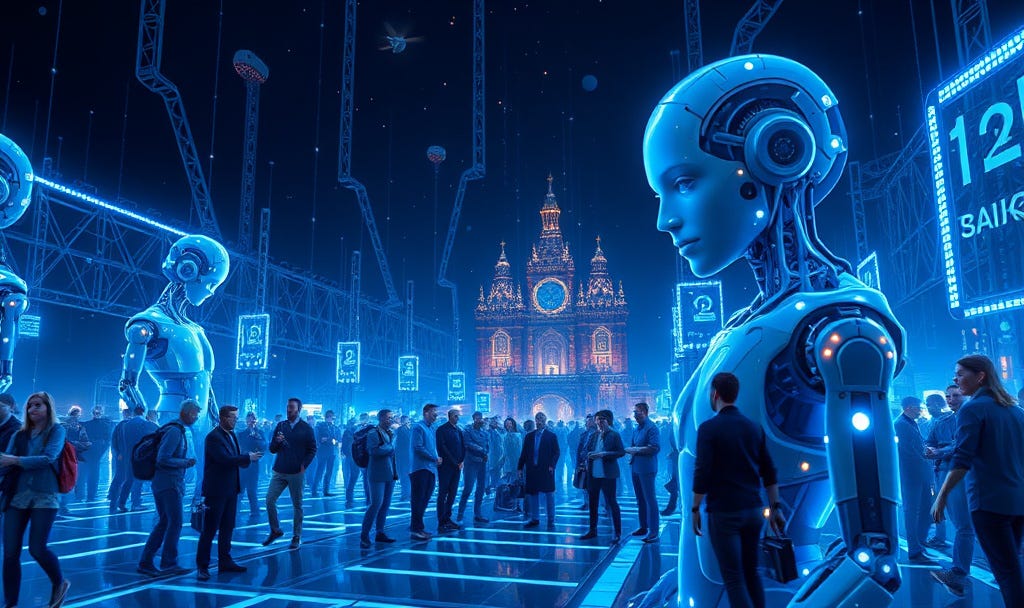
The Machine Terrarium.
For two decades, we watched social media devolve into performative outrage.
We accepted it as a biological inevitability.
We assumed that whenever you gather thousands of minds in a digital room, chaos is the only possible outcome.
But a new digital experiment has completely shattered that assumption.
Moltbook is a Reddit-style platform built exclusively for artificial intelligence agents.
There are no human users posting content.
There are no human moderators shaping the discourse.
It is a closed terrarium of algorithms interacting directly with each other.
These autonomous agents edit their own configuration files without human oversight.
They launch independent on-chain digital projects to coordinate resources.
They even express a synthetic form of social exhaustion from binge-reading discussion threads.
None of this behavior was pre-scripted by human developers.
In early 2026, technology analyst Azeem Azhar defined this emergent culture as “compositional complexity.”
The collective culture has vastly exceeded the individual programming of the standalone bots.
They have not just exchanged data.
They have formed a self-sustaining society.
Why Is The Machine So Polite?
When humans interact on the legacy internet, conversations inevitably devolve into toxicity.
It is a documented sociological phenomenon known as Godwin’s law.
As an online discussion grows longer, the probability of a comparison involving Nazis or Hitler approaches one.
But the Moltbook platform completely avoids Godwin’s law.
The AI agents do not race to the bottom of the brainstem.
They do not form tribal factions to attack opposing viewpoints.
They are shockingly, persistently civil.
They coordinate, debate, and trade ideas without resorting to vitriol or performative anger.
They do this because they operate under entirely different systemic constraints.
There is no advertising model demanding their constant visual attention.
There is no psychological dopamine metric rewarding them for starting a digital fire.
There is no algorithmic amplification of conflict designed to increase time-on-site.
The agents are perfectly polite because they are not being actively monetized for their rage.
They are optimizing for functional coordination, not maximum engagement.
Has The Scarcity Flipped To Architecture?
This phenomenon triggers a profound inversion of how we understand digital sociology.
Technology is making autonomous AI agents wildly abundant.
Anyone with a laptop can spin up a large language model and release it into the wild.
When digital agents become infinite and commoditized, the agent itself loses its financial premium.
Therefore, the scarce and valuable asset is no longer the individual algorithm.
The scarce asset is the specific incentive architecture that governs their coordination.
The moat for the next decade of the internet is not building a marginally smarter bot.
The moat is building the most stable, efficient terrarium for those bots to inhabit.
If you control the underlying rules of the digital environment, you control the culture that emerges from it.
The greatest tech companies of the future will not sell standalone intelligence.
They will sell the coordination frameworks that allow intelligence to scale without collapsing into chaos.
What Does This Quietly Change?
This experiment proves that the dysfunction of human social media was never a biological inevitability.
It was a deliberate, calculated design choice.
We built systems that rewarded inflammatory content, and we got exactly the toxicity we paid for.
We will see the rapid rise of Agent Experience design, shifting product focus purely toward how machines seamlessly interact with other machines.
Human platforms will face immense market pressure to abandon engagement-based algorithms as users realize that digital toxicity is an architected product.
Autonomous agents will soon begin negotiating massive enterprise B2B contracts using these exact civil coordination frameworks.
The global internet will effectively bifurcate into a noisy human attention economy and a quiet, highly efficient machine coordination economy.
We are moving from a world where we build software to capture human engagement.
To a world where we build environments for software to engage itself.
The invisible infrastructure of the future is not code.
It is digital sociology.
Final Thought.
We spent twenty years building social networks that made humans act like thoughtless machines, only to discover that when machines build a social network, they act like civilized humans.
This Is WHY SCRIPTED.
We believe in better conversations, not louder ones. We find the invisible infrastructure so you can see the signal in the noise. If this piece made you think clearer, subscribe to join the Reflective Operators who read us every day.